Patrick McCurdy on Nasa McCurdy
David Kennedy Sr. was an eighteenth-century farmer in the part of Cumberland County, Pennsylvania, that is now Franklin County. While little is known about him, he had a fairly prosperous farm at the confluence of the east and west branches of Conococheague Creek. When he died in 1769, his executors made an inventory of all his property.
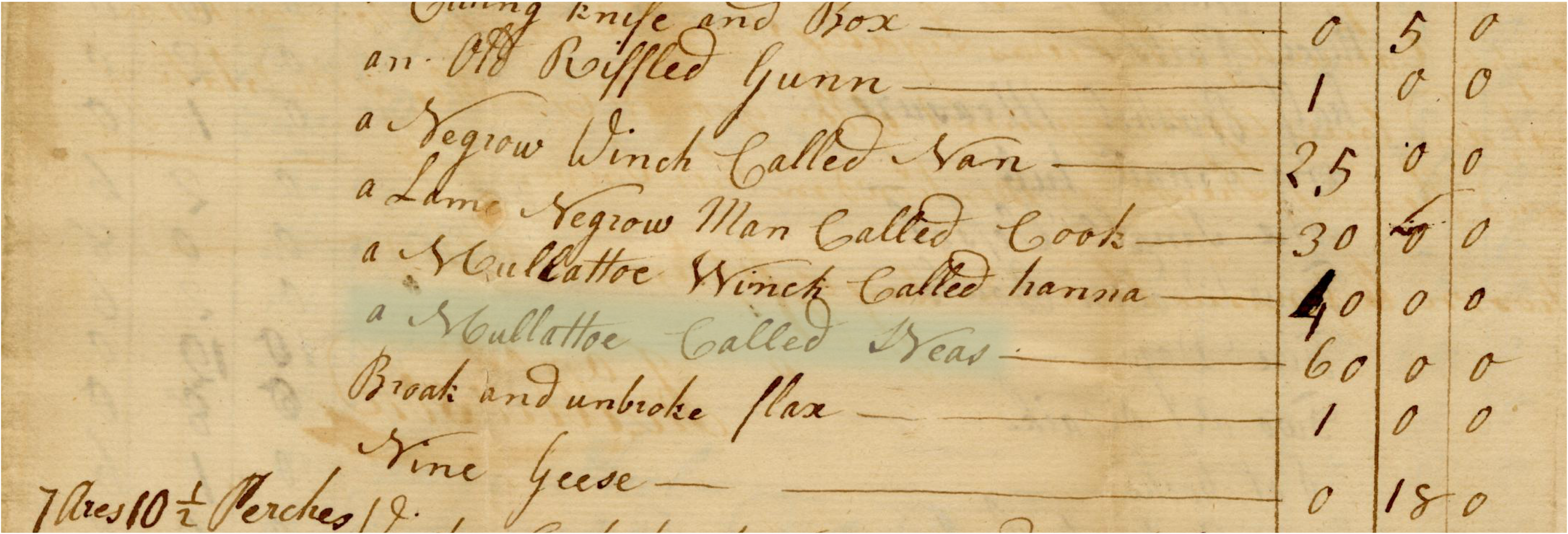
Listed along with the guns and the geese were four slaves, Nan, Cook, Hanna, and Neas. The first two are documented as "Negrow" while the latter two are shown as "Mulattoe." Most formal records from that time were careful to differentiate the two. Nasa would later be known as Nasa or Nase, though it is not known why he chose the name McCurdy. Within that inventory the word "plate," as in dinner plate, was spelled "pleat." Said with a Scotch-Irish brogue, "Neas" would be pronounced "Nase."
Slavery existed in all thirteen of the original U.S. colonies. While it faded out in the north by the time of the Civil War, it faded more slowly in rural areas than in urban centers. In South Central Pennsylvania, slavery was quite common in the mid eighteenth century, with about one in ten farms having at least one slave.
Rising pressure against slavery in Pennsylvania led to the passage in 1780 of "An Act for the Gradual Abolition of Slavery." This law required that all current slaves be registered and permitted them to be owned for life. Any children born to a slave mother after that point were to be treated more like indentured servants than slaves and were required to work for the mother's owner until age twenty-eight—an arrangement that Cory James Young calls "term slavery." Although slavery did indeed fade in Pennsylvania, it persisted until the Civil War Era.
The Quakers were the loudest voice speaking out against slavery in Pennsylvania, though even amongst the Friends it was a controversial subject. But if Scotch Irish farmers in Cumberland County were hearing antislavery talk coming from the Friends, they certainly were not hearing it in their Presbyterian churches. The 1780 slave registry lists four people with a profession of "reverend" in Cumberland County—all were Presbyterian. In fact, no major denomination other than the Friends took an official stance against slavery before the Revolution.
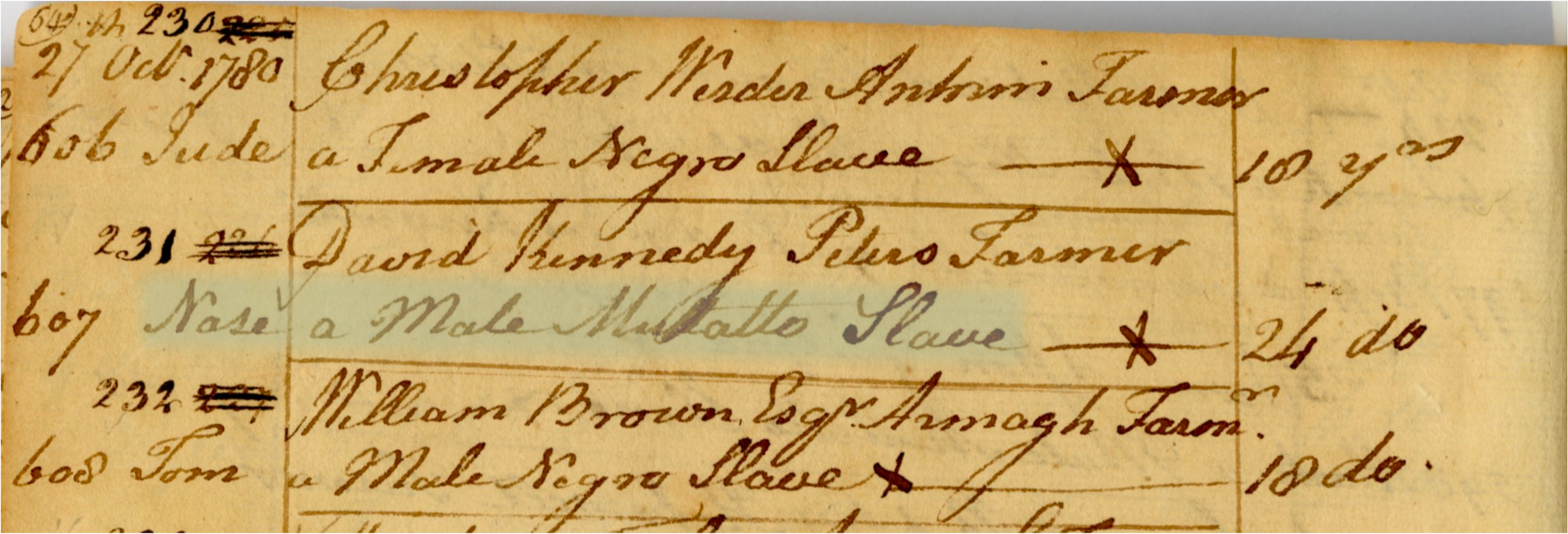
There is no record of David Kennedy Jr. inheriting Nasa McCurdy, but immediately after his father's estate was settled, David Jr. is shown in tax lists with a single slave where he had never had one before. In 1780, in accordance with the law for gradual abolition, David Kennedy Jr. registered a twenty-four-year-old slave named Nase.
In subsequent years David Jr. would be documented as "insane" or a "lunetik." It is not clear whether this was ranting mental illness or maybe just incapacity due to something like a stroke, but his wife, Rachel (Frazier) Kennedy, would have struggled to support her family which included four children.
In 1795, Rachel freed "Nace McCurdy" in a written manumission, mentioning that he had been born in bondage. Curiously this was not a legal manumission. Her mentally ill husband, David Kennedy Jr., was still alive and Nasa belonged to him by right of inheritance. Slaves were seen as chattel property and a wife could not sell or free the property of her husband. Two years later, with her husband now dead, she formally freed Nasa with a new manumission, specifically mentioning his help during the period of her husband's "insanity." Nasa then took up residence in Greene County, Pennsylvania, near where Rachel lived with her second husband.
The record is a bit fuzzy, but it would appear that Nasa had some respect amongst the local community, perhaps for his service to Rachel and her children. Twice, people of status in the area seemed to intercede on his behalf to get him set up with a farm on the Monongahela River. It was on this farm that Nasa raised a family of four boys and five girls with his white wife, Hannah.
Of the four boys, two are documented as having assisted runaway slaves by way of the Underground Railroad.
In 1856, a group of slaves later known as the Clarksville Nine ran away from their owner in Clarksville, Virginia (now West Virginia) and headed north through Pennsylvania. Robert Thompson was among them and in later interviews said they were found and hidden by Joseph McCurdy. Thompson also mentions that Joseph's brother William was involved. Family tradition has it that Nasa McCurdy Jr. was involved is such activity when he lived in Zanesville, Ohio, a known terminal on the Railroad. All the brothers except Joseph would eventually move to Amherstburg, Ontario, a town known as a destination for runaway slaves. With the Fugitive Slave Act of 1850, no escaped slave was ever truly safe until they were out of the United States.
Any former slave from the eighteenth century is almost certain to have famous and accomplished descendants, but Nasa seems to have more than his share. These are just a few notable ones.
The Industrialist
Joseph McCurdy's son, William H. McCurdy (1853-1930), started from nothing as a farm boy who later swung a hammer as a carpenter. He did well in real estate before getting into buggy manufacturing, selling both those and gas engines to Sears. He later built the largest truck body factory in the country and had extensive orders for those from the government during World War I.
The Physician
William McCurdy's daughter, Sarah Helen (McCurdy) Fitzbutler (1847-1923), raised a family before going to medical school and becoming the first African American woman to practice medicine in Kentucky. She specialized in obstetrics and gynecology, catering to the African American population in Louisville. She continued to run the local medical college (now Fitzbutler College, part of the University of Louisville) with her husband until her death in 1923.
The Attorney
Nasa McCurdy Jr.'s great-grandson, Merle McCurdy (1912-1968), worked on Great Lakes ore boats and as a bellhop as he put himself through law school at what is now Case Western Reserve University. He made a name for himself as a civil rights lawyer and was appointed by Attorney General Robert F. Kennedy as the first Black U.S. Attorney for the Northern District of Ohio. His distinguished legal career was cut short by an untimely death at age 55.
The Professor and Civil Rights Leader
Nasa McCurdy Jr.'s other great-grandson, Howard Douglas McCurdy (1932-2018), received his Ph.D. in microbiology and chemistry from Michigan State University. He headed the Department of Biology at the University of Windsor. Leaving academia, he was elected as the second Black Member of Parliament in Canada. A noted civil rights leader, he continued to serve in various capacities after leaving Parliament.
Patrick McCurdy is a retired physician assistant with a keen interest in history and race. Brought up white, research into his family tree brought an unexpected surprise in the form of an enslaved ancestor, his second-great-grandfather, Nasa McCurdy.