Statement of Ethics
What are the moral stakes of borrowing the title of this project from a slave registration? Surely there are other sources from which to draw, or perhaps other potential titles lurking within slavery’s archive. Indeed, the registrations themselves occasionally animate Black life even as they commodify it. Consider the following examples.
Tom was compelled by his enslaver to register himself and another man named Sam in Northampton County. That he was the “bearer of this” return reveals his awareness of the location of the county courthouse in Easton as well as his knowledge that the clerk’s registry was housed there.
![A short, typewritten copy of Abner Barker’s return of a boy named William. Highlighted in green are the words and phrases “Charlotte [sic] … was Delivered of … William.”](/images/Ethics1-Tom.png)
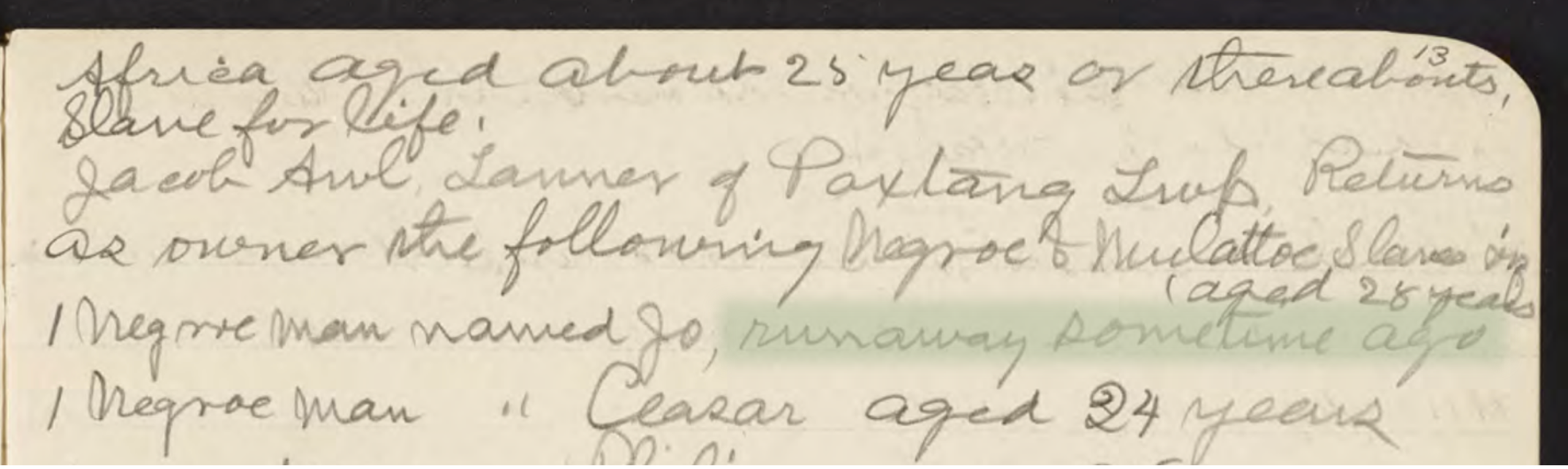
Then there was Jo, who was registered by his enslaver further east in Lancaster County—now Dauphin County—despite his having “runaway sometime ago.” Unlike Tom, Jo’s mobility frustrated rather than assisted his enslaver. His determined absence is present in this document.
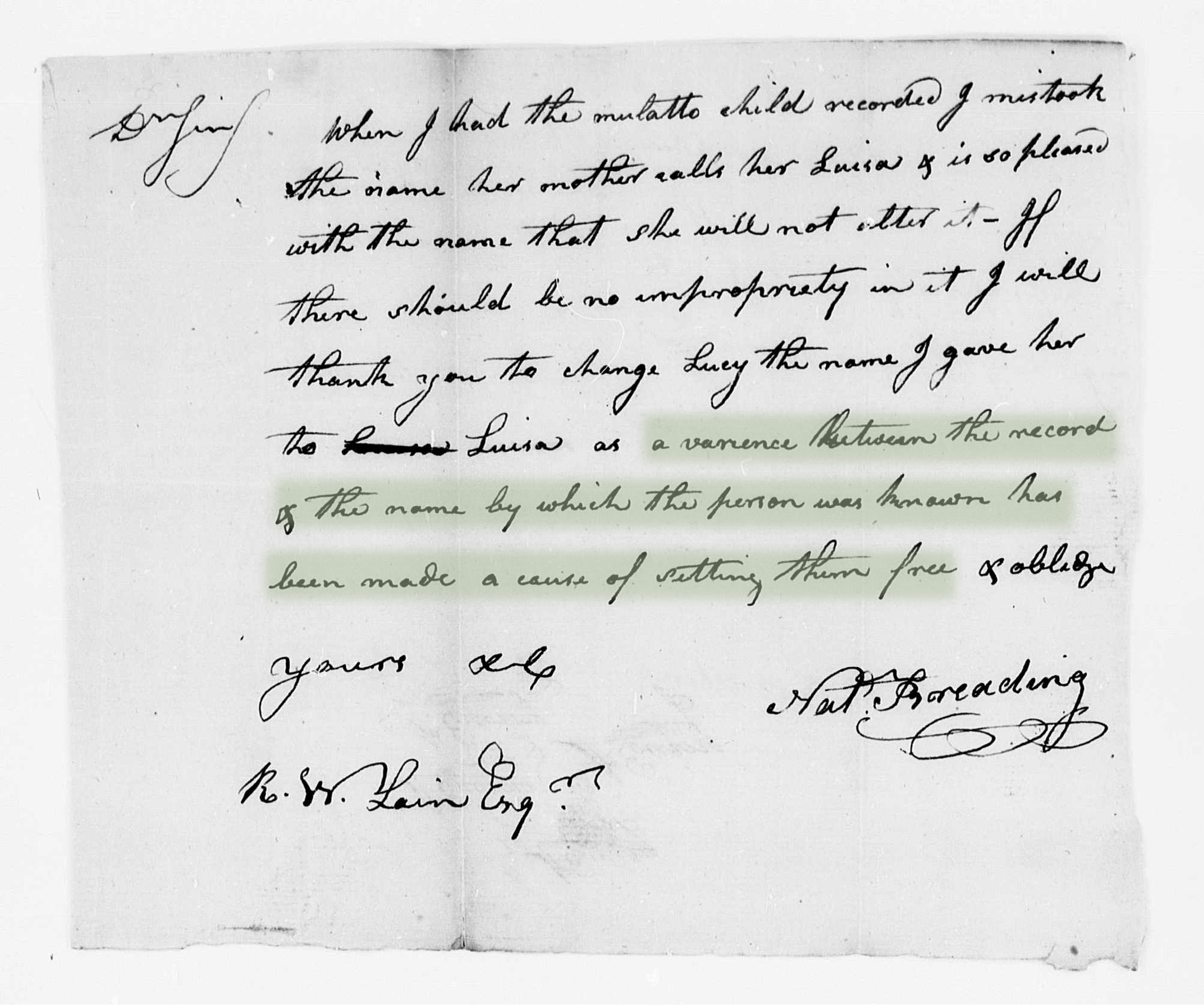
Others made their presence felt through their commitments to their families. Luisa’s mother, whose own name does not appear in the slave registrations, insisted on calling her daughter Luisa by a different name than the one her enslaver enslaver initially put to paper in Fayette County. Her insistence that she retained the right to name her child threatened Pennsylvania’s enslaver bureaucracy.
Finally, there was Priscilla in Washington County, who went further than Luisa’s mother by expressly refusing to speak her daughter’s name. She did this because she was “under the impression that [she] cannot otherwise be recorded.” Her enslaver named the child Maria, claiming her as his property anyway. Tragically, this document reveals Priscilla’s failure to prevent its existence.
![A handwritten document on faded paper with dark, bleeding ink by which John Hoge registered a child whom he called Maria. Highlighted in green is that fact that the child’s mother, Priscilla, “will not name [her] under the impression that it cannot otherwise be recorded.”](/images/Ethics4-Priscilla.png)
Tom, Jo, Luisa’s mother, and Priscilla all left their mark on slavery’s archive. Phrases inspired by their actions—To Bear This, Absent Presence, Variants of Freedom, To Record Otherwise—all make for fine titles. Yet none of them capture the core mission of this project.
A Just and True Return (JTR) identifies, aggregates, encodes, and disseminates the archival remnants of Pennsylvania’s county slave registrations. Formatted this way, the registrations hum with life. Black kinship networks survive in documents that were meant to catalog and to enslave people, not connect them to one another.
Furthermore, enslaved people and their abolitionist allies, Black and white, transformed the slave registrations into objects of liberation in their own lifetimes. Whenever people were not registered, or were registered improperly, antislavery activists sued for freedom. Jennie K. Williams has written that “Data wrought from slavery’s archive … cannot and should not be transformed.” This principal is essential to JTR, as a missing document, or even a missing word or phrase, had the potential to be emancipatory.
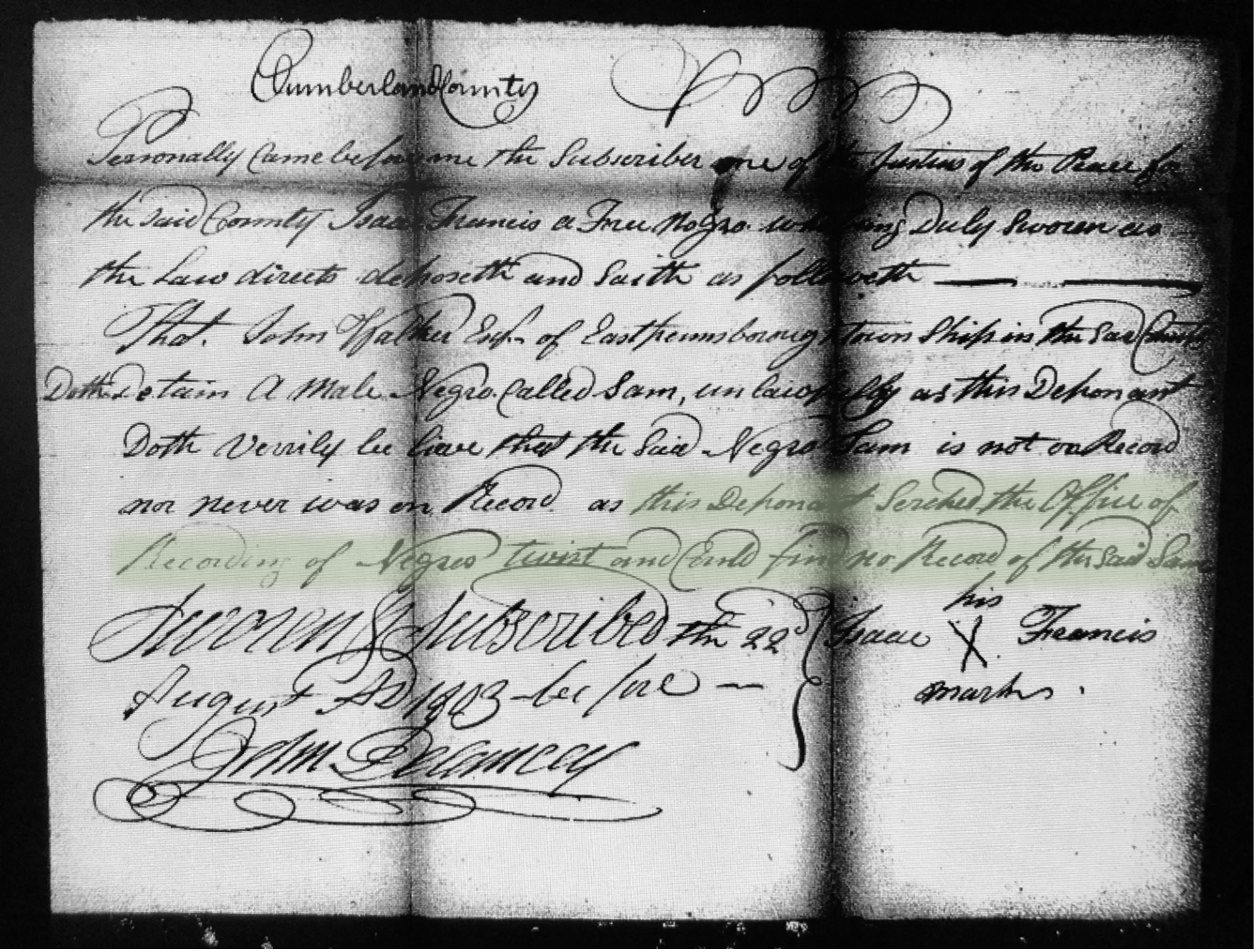
Isaac Francis understood this. A free person of color, Francis spent a few sweltering hours in the summer of 1803 searching through the Cumberland County courthouse in Carlisle, Pennsylvania attempting to liberate a man named Sam. “[T]his Deponant Serched the Office of Recording of Negres twist,” Francis testified, “and Could find no Record of the said Sam.” JTR preserves these absences, not specifying what the documents leave unspecified as a gesture to the fact that some of these slave registrations begat freedom papers.
Williams insists forthrightly that slavery’s data must be “made to respect what has been disrespected and to honor those who have been dishonored.” Pennsylvania’s slave registrations served cross purposes historically, but even if they had not, we have the power in the present to transform the meaning of “A Just and True Return” for the better.