Introductory Essay
On Abolition’s Archive
It is true that in 1780 Pennsylvania became the first U.S. state to pass a law for the abolition of slavery (although the independent republic of Vermont wrote an abolition clause into its constitution three years earlier). It is also true that most U.S. states that joined Pennsylvania in pursuing abolition copied its gradual, legislative approach (although Massachusetts and New Hampshire achieved similar results through constitutional interpretation).
Still true but less appreciated is the fact that Pennsylvania’s gradual abolition program created a vast archive of slavery—seemingly vaster than any of its northeastern neighbors. Of the five states that legislated gradual abolition programs in the early US republic, Pennsylvania required the most paperwork. It was Pennsylvania—and only Pennsylvania—that required both the registration of individuals born before the law’s passage and those born after.
Gradual abolition’s architects wanted to ensure that the state could distinguish between people whom enslavers claimed as property for life and children whom enslavers claimed as property until the age of twenty-eight. However, the repetitive practice of identifying people as property elided some of the distinctions between these groups, scaffolding the rise of a system of hereditary term slavery in which enslavers detained multiple generations of Black families as chattel. Evidence of this mostly novel system of bondage abounds in Pennsylvania’s surviving county slave registries.
A Just and True Return makes this archive more accessible to scholars, students, and descendants by centralizing records, making them searchable, and ultimately transcribing them. It invites users to discover for themselves the people and the processes at the heart of Pennsylvania’s gradual abolition program.
A Just and True Return
The title of this project comes from a registration document. In the wake of the American Revolution, a young mother whose name was almost certainly Peg lived in Shippensburg with her five children, Palm, Ruth, Nell, Pegg, and Jo. A veteran named Robert Peebles claimed the family as his property, submitting a “Just and true return” of the names of Peg’s children to the Cumberland County clerk in 1788. This act of registration gave legal life to the longstanding American principle of partus sequitur ventrem—"that which is born follows the womb”—permitting Robert to hold the children in bondage for decades.
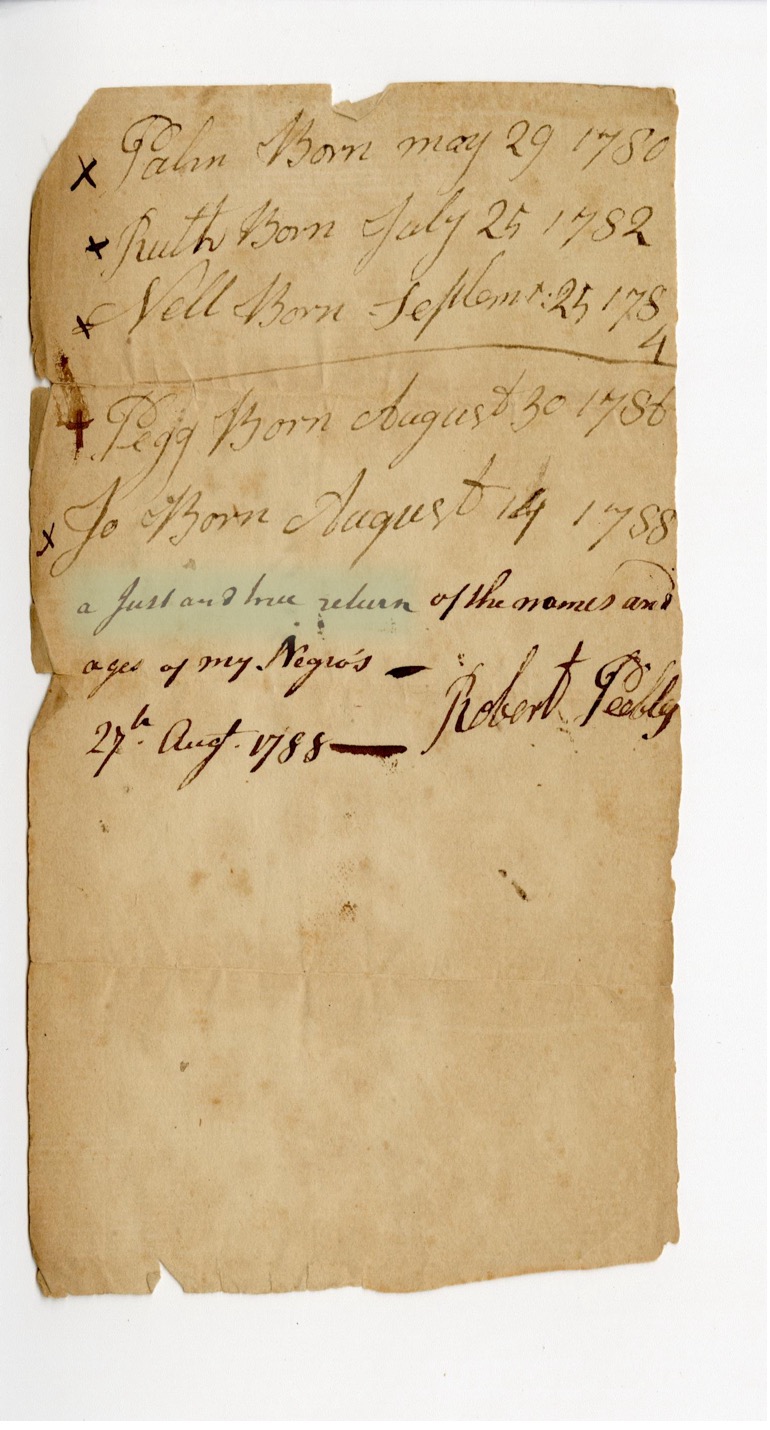
Peg was born before Pennsylvania enacted its gradual abolition law, meaning that Robert was legally able to register her as a lifelong slave in 1780. Peg’s five children, however, were born afterwards, meaning that Robert could only register them as term slaves, bound to serve until they turned twenty-eight (that is unless they became pregnant or ran away, in which case Robert could petition a judge to extend their bondage). Peg’s three daughters, Ruth, Nell, and Pegg, risked passing their term-enslaved status onto any children they had before aging into freedom. The Pennsylvania Supreme Court tolerated this practice of hereditary term slavery until 1826.
Like so much of slavery’s history, the above narrative relies on an assumption: that Peg was the mother of Palm, Ruth, Nell, Pegg, and Jo. Robert Peebles’ 1788 return of the children does not specify this fact—although some returns did just that. The evidence in favor of Peg’s maternity is circumstantial, but compelling. Peg was twenty-seven years old and thus of child-bearing age when Robert registered her in 1780. She was also the only person whom Robert registered in 1780 (or paid taxes on, for that matter). Palm was born the same year, and a daughter sharing Peg’s name was born in 1786. In short, Peg is the most sensible candidate for the mother of the five children whom Robert claimed as his own property in 1788.
For almost two-hundred-and-fifty years, the pieces of paper connecting Peg and her children were essentially static legal records. They were not created to connect enslaved people, but rather to distinguish between those who were enslaved for life and those who were enslaved for a term. Yet these records do link people. Although not required by law, enslavers in several counties habitually named the mothers of the children they were claiming as their property. Of the nearly 6,350 registrations in this database, roughly eight-hundred, or eight percent, identify maternity. A Just and True Return facilitates dynamic searching and makes these relationships transparent.
![A short, typewritten copy of Abner Barker’s return of a boy named William. Highlighted in green are the words and phrases “Charlotte [sic] … was Delivered of … William.”](/images/Intro2-BarkerDocScan.png)
This project is intended to serve as a kind of reparative justice. The information contained within these documents—these “slaves returns”—must be returned to the descendants of those whom they purport to describe. So, too, must they be made available to researchers seeking to understand Pennsylvania slavery during the age of gradual abolition.